
A Salento Photography Holiday in Maglie, Otranto, Gallipoli and Lecce

Our evening in Gallipoli ended on the old town wall, watching the sun drop behind a cloud bank above the lighthouse on the Isola di Sant'Andrea. The sea went silver first, and then gold, and every camera in the group stayed pointed west.
That was one evening of a Salento photography holiday I tutored for Flavours Holidays from 26 September to 3 October 2026. We were based at Palazzo Garzia in the centre of Maglie, and we photographed Maglie, Otranto, Gallipoli and Lecce. The teaching covered composition, black and white, and Lightroom Classic editing, and all food and wine were included.
Four towns in a week sounds like a lot of ground for a relaxed holiday. Why did it never feel rushed?
Why Maglie works as a base for a Salento photography holiday
Maglie is central enough that each of the other three towns is an easy day out, and good enough to photograph in its own right that the days at home never felt like rest days.
Palazzo Garzia did much of the work. The rooms are spacious and beautifully equipped, the large central courtyard is the building's heart, and an outdoor pool cools us off on warmer afternoons. Two dedicated cooks prepared most of our meals there, so after a long day of shooting, we started the evening with dinner rather than searching for somewhere to eat.
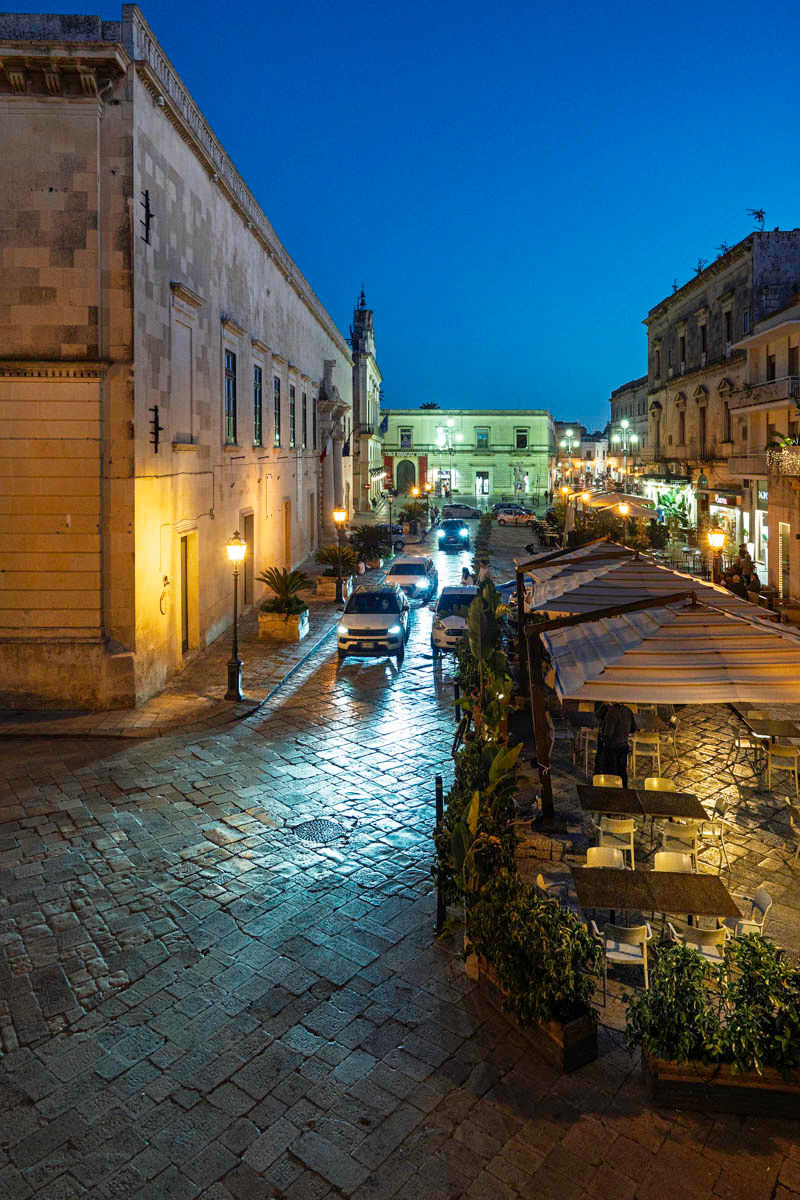
The town itself rewards a slow walk. Pale limestone, deep doorways, and arcades cast hard shadows by mid-morning, and I found myself collecting doors so often they became a montage of their own. A few of those doors came from the other three towns, but most were from Maglie.

Otranto and the habit of looking for a frame
The quickest way to improve a street photograph in Otranto is to stop photographing the view and start photographing the alley that leads to it. Otranto sits on the Adriatic, and its narrow cobbled streets open onto the sea without warning.
That made it the right town for the composition session. Of the composition habits I teach, Otranto offered at least four on every corner:
Framing, through arches, doorways and the gaps between whitewashed walls
Leading lines, in the cobbles and the shadows running down to the water
Balance of visual weight, with two small figures against the mass of the castle walls
Visual hierarchy, where people pull the eye before anything else in the frame
Inside the cathedral, the group found the other half of Otranto. The twelfth-century mosaic floor runs the length of the nave, and the gilded ceiling above it is pure pattern, making the building as much a lesson in texture as in composition.


Black and white in Gallipoli and Maglie
A strong black-and-white photograph needs simplicity first, then at least one of three things. Those are shadow and contrast, bold shapes, or texture and pattern. Early autumn Salento supplies all three in abundance.
Gallipoli proved the point at sunset. In colour, the sun behind the cloud bank is warm and gold. In monochrome, the same scene becomes a study in contrast, with a bright disc, a black horizon and a sea full of reflected light. Both versions are in the gallery.
One pair of photographs from Maglie in the gallery shows the same idea at street level. A woman walks past a shop window with two mannequins, and I processed the frame in both colour and black and white. In colour, the eye goes to the shop sign and the plants. In black and white, it goes to her stride and the mannequins, which echo her pose. Nothing about the composition changed. The hierarchy did.
The other lesson I repeat on every holiday is to shoot wide and crop later. Leave room around the subject, because you can remove pixels at the computer, but you can never add them. The Lightroom Classic demonstrations at the palazzo showed how that habit paid off: we chose the final crop and aspect ratio once we were back at the table, not in the street.


Lecce, the Florence of the south
Lecce earns its nickname within an hour of arriving. The local limestone carves like wood when it is fresh from the quarry, and the cathedral and the city's churches are covered in carved detail on a scale that is hard to take in from street level.
Lecce also shares a history with Venice. Venetian merchants traded in the city, and in 1543 their community built the small church of San Marco in Piazza Sant'Oronzo, right beside the Sedile. The Roman amphitheatre is a few steps away. In the gallery, you will find the amphitheatre photographed through a triangle of carved stone, which is the framing lesson from Otranto applied to a Roman ruin.
We ate out twice during the week. Once, we had wood-fired pizza at Malliè in Maglie, and once, we had dinner at La Vecchia Osteria da Totu in Lecce. Every other meal was cooked for us at the palazzo.


The week in photographs
A Salento photography holiday gave five photographers a set of towns, each teaching something different. Otranto and Maglie teach framing, Gallipoli teaches light, Lecce teaches texture, and Maglie teaches patience. The full set of 79 photographs, from the palazzo courtyard to the Gallipoli sunset, is on my Puglia 2026 gallery page.
My thanks to Flavours Holidays and to the five photographers who spent the week with me. If you have photographed the Salento yourself, I would be glad to hear where you went. Leave a comment below.
Comments